

Some arguments against Catholicism don’t fail because they ask hard questions. Rather, they fail because they set false parameters.
A false parameter is when someone defines the terms of debate or an argument so narrowly, inaccurately, or artificially that Truth is disqualified before the discussion even begins. (continues below the video)
It works this way. Someone sets a narrow standard—usually a theological, historical, or scriptural one, built entirely on Protestant assumptions—and then demands that Catholics answer to it. If the Catholic can't fit their answer inside those parameters, the Protestant calls it a win. But the problem there is the parameters being set were faulty. They didn't belong there in the first place
It isn't honest inquiry at all, it's more like demanding that a boulder fit through a hole designed only for pebbles. That's a false parameter. Here are three of the most common ones.
1. "Show me where the Bible says that."
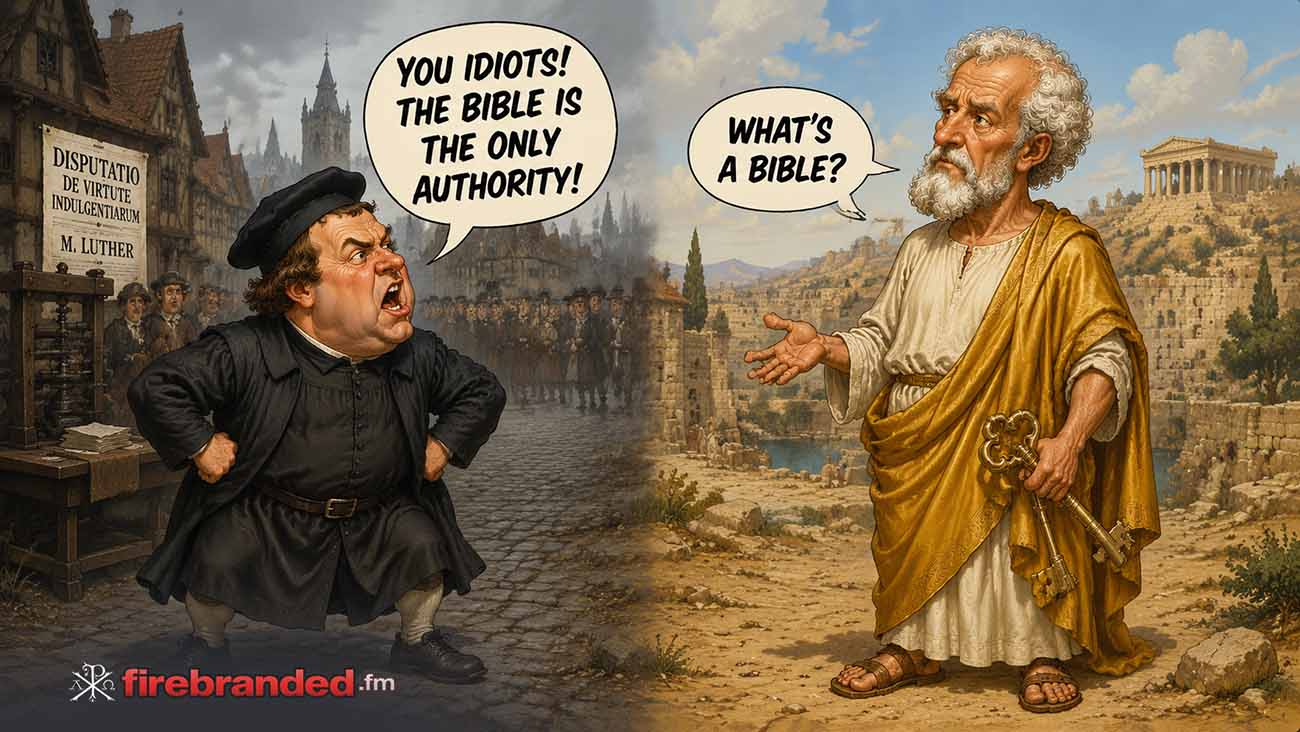
The demand sounds reasonable. If it's true, it should be in Scripture, right? The problem is that this isn't a neutral standard — it's a Protestant one. The idea that Scripture alone is the final authority on everything is itself a doctrine. Catholics don't accept it. And here's the thing: the Bible never actually teaches it either. There's no verse that says "Scripture alone is sufficient for all matters of faith."
It goes deeper than that. The Bible's canon — the list of books that belong in it — wasn't settled by the Bible itself. It was settled by Church councils. The same Church whose authority Protestants reject is the one that handed them the Bible they're now using to challenge it.
So the measuring stick being used to evaluate Catholic doctrine is a doctrine Catholics reject, backed by an authority Catholics don't recognize, applied to a canon that wouldn't exist without the very Church being questioned. That's not a neutral starting point. That's a circular argument dressed up as a challenge.
The correct parameter: Does this doctrine have a basis in Scripture, Tradition, and the teaching of the Church — the three pillars of how Catholics actually do theology?
2. "Explain how 1,500 years of Christian history fits into my version of Christianity."
It doesn't. And that's not a problem with Christian history.
Protestant Christianity, in its various forms, developed in the 16th century. But when you use a 16th-century framework to evaluate fifteen centuries of Church history that came before it, you're going to keep finding things that don't fit. And if your conclusion is always that the history is wrong, at some point you have to wonder whether the framework is the real problem.
The early Church had bishops with real authority. It had a liturgy (the Mass). It had absolute belief in the real presence of Christ in the Eucharist. The writings of the early Fathers—the people who were closest in time to the Apostles—reflect a Church that looks far more Catholic than Protestant. When the history gets filtered through a framework that didn't exist until the 1500s, none of that can be seen clearly.
(continues below)
The correct parameter: What does the historical record actually show, read on its own terms, without being pre-screened by a theology that came fifteen centuries later?
3. "John 6 (Holy Eucharist, Bread of Life) is obviously symbolic."
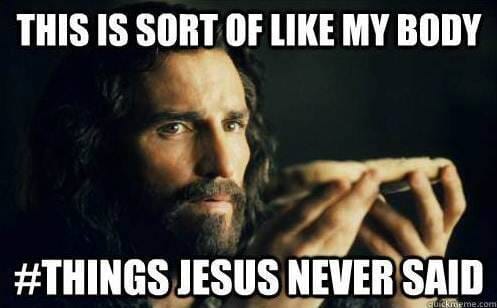
This one has an irony to it. The usual Protestant argument is that Scripture's plain meaning is accessible to any reader on its own. Fair enough, so read John 6 plainly.
Jesus says his flesh is real food and his blood is real drink. The crowd finds it too hard to accept and starts walking out. He doesn't stop them and say he was speaking figuratively. He lets them go. The disciples who stay do so because they take him at his word, not because they understood it right away.
If the standard is the plain reading, the Catholic is the one following it. The Protestant position actually requires reading past what the text says to get to a symbolic meaning that isn't there. The parameter cuts against the person who set it.
The correct parameter: What does John 6 actually say, how did the earliest Christians understand it, and does the Church's teaching on the Eucharist represent a faithful reading of that text?
All three of these follow the same pattern. A Protestant assumption gets placed on the table as if it's neutral ground, and then Catholics are asked to defend their faith on someone else's terms. Before you accept any measuring stick, it's worth asking where it came from, because a standard built on a false premise is going to produce a false result every time, no matter how confidently it gets applied.
Hey, you belong here. Subscribe to Firebranded.fm and be part of my Inner Circle. Quit wasting time, Jesus could show up at any minute


Member discussion